GRAND THEFT AUTO V REVIEW: ALL OF THE CITY

No comments

Sunday, October 6, 2013


Reviewed by: Jamaal Ryan
As you’re passively walking along the city streets, if a non-law abiding citizen boards a city bus, kicks the driver in the face, then throws him out, and the same bus driver returns the favor and takes off recklessly, you know you’re playing GTA. If a Spanish speaking wanna-be border patrol trainee is demanding your passport and begins ranting about how illegal immigrants are ruining the American dream, you know you’re playing GTA. If you fly a crop duster into a cargo plane, kill everyone in it, fly it, then jump out and parachute to earth as you watch the jet plunge into the sea, then you know you’re playing GTA.
Grand Theft Auto has earned its notoriety as one of the most outlandish, and most ambitious video game franchise known to both the hardcore and general audiences alike. No game has quite subversively criticized American culture quite like GTA, no game has allowed the level of interactive freedom quite like GTA, and no game has replicated a living city quite like GTA.
Grand Theft Auto V is a force to be reckoned with, bringing the power of “three” to many facets of this installment. Three lead characters elicit three different perspectives and in some cases, three ways to play. The game mechanics have been refined, taking assets from three of Rockstar’s strongest previous games. There are three major ways to earn cash which create a meta game within the city. And its sheer size eclipses Red Dead Redemption, GTA IV and San Andreas combined.
With that said, GTA V isn’t the best Grand Theft Auto it can be, but Rockstar’s ownership of the open world genre and systems integration sets this game to be a generational defining title.
Franklin. Michael. Trevor.
GTA V’s three main characters come from different backgrounds which are well represented by both their mannerisms and the depicted culture of their parts of San Andreas.
Michael is a retired bank robber, reaping his monetary benefits occupying a Vinewood mansion in witness protection and wallowing in self-pity and self-conflict as he laments the long since passing of his prime age and the disdain that his despicable family has for him. Trevor is a disturbed individual, an intelligent psychopath emergent from the cesspool of the northern country side who’s in a sustained angered and manic state whose unpredictability - which oddly encompasses brief moments of societal compliance for the success of the job - always has the player on edge. Franklin's hood style "yes mutha f**ka" adherence to issued requests painfully recalls the errand boy status of past GTA protagonists. And while he himself isn't entirely compelling, his banter with his boy Lamar makes for some of the best exchanges in GTA V.
GTA V brings these unlikable three together in a way that’s both enjoyable and painful to watch. Their interactions contain hilarious exchanges as well as mindless, unproductive bickering. Michael is the source of gravity here, though never really taking away from both Trevor and Franklin’s individual so-called character arches. Franklin is the son he never had, and Trevor is the brother he can’t get away from. The chemistry of all three mainly works when the comradery cycles in a specific direction.
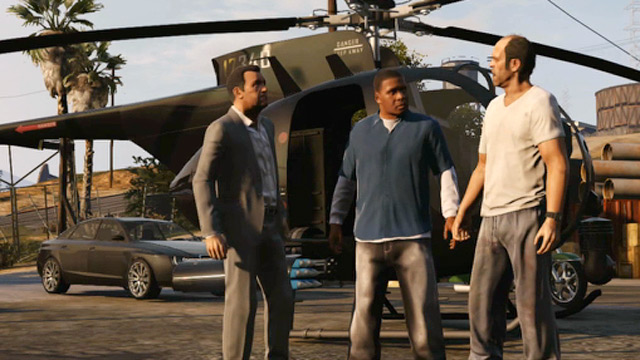
The troubled three
The hook involving these three is the character switching, allowing you to jump from one protagonist to the next – regardless where they are or even what they’re involved in – within San Andreas. It’s a narrative justification for all the antics that each of the three get into instead of having one jack-of-all lead, it works as a quick way to get from one end of the city to the next, and most excitingly, it divides missions into different perspectives between two or three of the characters.
While this mission structure approach works, it doesn’t quite operate the way in which many of us have hoped. The assumption building up to GTA V’s release was that character switching will be available anytime during a mission; I want to play as Franklin instead of Michael because his engagement is more interesting at this present time. But for the most part, this simply isn’t true. Many of these missions are divided into sections, using each character to move from one playstyle to the next. First you’ll play as Trevor, then you’ll play as Franklin, then you’ll play as Michael. This underwhelming feel isn’t just from set expectations, it causes a more linear texture to a game that’s all about freedom.
Having said that, there are times when cycling between the three is available which is commanded by prompts indicating when one of the three has the advantage, and when one is in danger. When left to their own devices, they have a tendency to move away from your issued vantage point which spoils most strategies involving boxing in the enemy. Thankfully they never put themselves in unjustifiable danger as they stick to a position that generally prepares them for the next monkey wrench thrown into shootouts. But even without the swappable freedom, the immediate transition from one character to the next almost ensures that the action is always at its climax.
When looking at each lead individually, the distinguishing attributes hardly differentiate one from the other. All three have identifiable special abilities. Michael can slow down time Max Payne style in shootouts, Franklin can slow down time while behind the wheel, and Trevor’s rage ability allows him to sustain less damage and output more. Though they sound great on paper, in my entire playthrough, I never once felt the need to utilize them. Character statistics are less meaningful, having various – but all minor – effects on the gameplay itself. In the end, Trevor, Michael and Franklin may be vastly different as written characters, but not as playable avatars.
Acceptable and Unacceptable Satirical Narrative
The story mainly works as long as you remain invested in the snappy dialogue, Rockstar's bread and butter. It's lighter hearted and because of this, proving to be less focused than GTA IV. But its biggest fault is its failed sense of direction and inconsistency. Throughout the campaign, the three involve themselves with undesirables that have no narrative tie-in until the game’s haphazard final mission. That’s not mentioning the story's turning point that concludes a campaign-long conflict that remains stagnant for far too long. But once you reach the game’s conclusion, you're faced with three choices, two of which offers a bitter tonal shift to the writing's flavor that would have been more appropriate in Niko's Liberty City. You can view all three with a save, but likely only one will satisfy.
While the story telling could have been better, Rockstar always pulls through with their unapologetic social commentary. Racist satire is in abundance, and everything from gun control to even the Travon Martin case finds its way into GTA V’s outlandish, albeit heavy handedly on the nose, and very relevant portrayal of western society.
However its satire can be taken too far. Nothing is filtered through Rockstar’s subversive lens, not even torture. Among the countless lives you’ll take throughout your mischievous gallivant through San Andreas, the intimate physical and emotional manipulation of one will remain as the most memorable. What was supposed to be a criticism on America’s preached, yet allegedly not always practiced, stance on methods of information gathering turns into a disturbing antithetical sequence that crosses a line even beyond Manhunt’s trivial mutilation. If and likely when media catches wind of this, Rockstar won’t be able to defend themselves with much more than their right as artists.
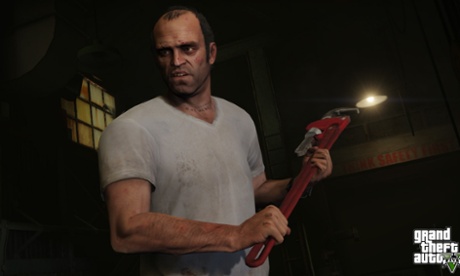
There's no preparing yourself for what's about to follow.
Next Gen Current Gen
As a technical feat, GTA V shouldn't be possible in current gen systems; but it defies that belief consistently. San Andreas’ astounding lighting is one of the most impressive I have ever seen in any game that money buy. It does an incredible job of emphasizing a sense of depth, presence, and vibrancy on everything it touches. The level of pervasive detail is unheard of, particularly in an open world game this size.
The draw distance is almost dizzying, looking like chopper shots of the Manhattan skyline. From the reachable back dropped buildings, to fog obscured hills, to the sun-bleached dirt of the countryside, GTA V owns the term, "as far as the eye can see". And I have to give Rockstar credit for making the first game to have me exclaim, "Whoa!" when I dove underwater for the first time, opening an entirely new and fully realized aquatic world.
The city’s independent activity demonstrates an unparalleled ecosystem. Events occur naturally virtually all the time without you ever having to touch a thing. Cop chases and shootouts erupt at random, sometimes startling your paranoid criminal instincts. Fights breakout between civilians, conversations carry out, car accidents happen; stand still long enough, and you’re likely to see something different every single time. And with a slight or brief push, this sensitive city will respond in a domino-effect fashion, eliciting a metropolis driven chain reaction.
Unsurprisingly, San Andreas' existence isn't a result of pure flawless execution. Glitches stratify on a wide spectrum, everything from occasional brief freezes entire landscapes missing. But from the sheer scope of San Andreas, to the crumbling destruction of a collapsing house, to the animated anatomy of organic faces -- eye balls, teeth, tongue -- very much like how Halo 4 redefined our expectations of the Xbox 360's hardware, GTA V is the very essence of the maximum power of the PlayStation 3 and Xbox 360.
Take away its moral vices, and it's truly magnificent.
Running through the blood vessels of GTA V exists a bit of an anthology of the developer's best games in the last 5 years, all indicating a culminating evolution of Rockstar. The moment you draw your first weapon, Max Payne 3’s heritage surfaces, with a powerfully magnetic cover system and slightly over powered soft (more like stiff) aim. It performs at its best outdoors as characters will stick to unintended surfaces when in corridors and close quarters. Though it’s tough to accredit Rockstar’s Midnight Club series, the driving mechanics have vastly improved, with tighter steering and cars that virtually never explode unless you want them to. Random event quests will appear spontaneously as you drive through the city just as they did with John Marston; and from Sandy Shores to the northern parts of Blaine County, the yelp of a coyote or the growl of a bobcat will trigger your Red Dead reflexes. Lastly, Rockstar has capitalized on the idea of what the Four Leaf Clover mission brought to GTA IV and made it the central theme for GTA V.
It’s all about the heists.
The Job
Heists function as payoff events in the story, sometimes bookending the results of premeditative missions that set up the big job, but all are heavily involved as they often drive you through an ever evolving and very mobile standoff that even stretches across a significant portion of San Andreas. Some missions will ask you to steal disguise vehicles to cover your infiltration, other times you’ll be placing a stolen car in a discrete location for the getaway. All missions in GTA V are replayable from the pause menu, however heists large in part make for worthwhile revisits depending on what you decide to do, and who you choose to bring in.
The degree in how each job plays differently rests on your hired crew and overall play style and approach. Most jobs offer two different methods of engagement; some are more discrete than others, but all those that offer split approaches are worth playing through twice just for experiencing two very different mission structures.
Most of these heists also allow you to employ specialists of different skill levels for the job. The more skilled the individual is, the larger the cut; the less skilled they are, the smaller the cut. Missions play out a lot smoother and with noticeable confidence involving higher level skilled specialists that make little to no mistakes. And though rookies get a smaller portion of the spoils, they panic, make poor decisions, and are more likely to lose their share by dying or getting caught. With the variable of how effective these hired crew members are, they add another layer of replayability to GTA V’s heists.
Not aborting for s**t.
These Heat style sequences make up for some of the most entertaining moments in GTA V, but that is to no discredit of the abundance of missions that almost never allow you to do the same thing twice: from engaging in a high speed sports car chase in a liberatingly wide airport runway while cars explode and fly into your field of vision, to shooting down a jet with a high powered sniper rifle then switching another character chasing down the descending aircraft on a dirt bike.
However, it’s important to be mindful of the game’s flawed mission efficiency. GTA V doesn’t always to a good job in indicating your task at hand. At times, it’ll flat out fail to notify you as you play. This exacerbates once the game kills the mission for doing the job incorrectly. And even when you know things have gone awry, having to fail the mission deliberately for a retry is almost as frustrating as restarting the mission entirely which has been fixed by the much needed checkpoint system. But when running smoothly, the level of enjoyment will almost certainly bring you back like an amusement park junky to a predictable yet thrilling roller coaster.
Triple Millionaires
You’ll be earning millions completing heists in GTA V; but within the game’s full economical system, you’ll earn that amount of cash several fold. Property purchasing is back which award sources of weekly income. Rockstar also attempts to integrate a monetary value in in-game events; and while the idea of having someone call me up and ask for my help at the threat of losing a significant amount of money is intriguing, these occurrences rarely happen and stand as an interesting idea falling short as a missed opportunity.
However the massive success here is the ebb and flow of the in-game stock market. It makes a minor introduction with little exposition, but can have a drastic impact on how your earn money. Listen carefully, and you’ll pick up on company movements that indicate which stocks to buy. Certain missions also affect stocks which act as subtle yet valuable tips on where to put you money. The market is also influenced by the GTA V’s real world community. You can count on every player purchasing weapons and ammo at Ammu-Nation, so that’s inevitably a profitable stock to invest in. Properties within Los Santos can cost up to $150,000,000 which is impossible to earn by story missions alone. Manipulating the stock market is your best means in acquiring such valuable assets.
A City At Large
For players like me who powers through story missions and side requests that offer directional play, it can be easy to forget that there’s an entire city to f**k with. More than ever, GTA V provides players with a massive city filled with a slew of activities to engage in. Throwing away money at the strip club, turning into an Iron Man at the triathlons, practicing your marksmanship at the gun range or hunting game in the northern woodlands, or changing pace in a tennis match or one of the golf courses, while none of these activities are entirely compelling as single experiences on their own, their mere existence as simply s**t-to-do best serve in helping San Andreas capture the feel of a fully realized, fully interactive city
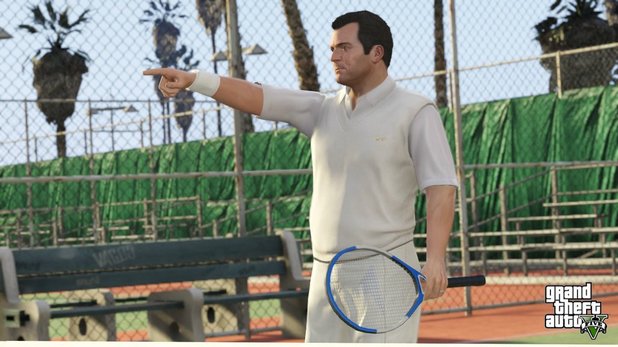
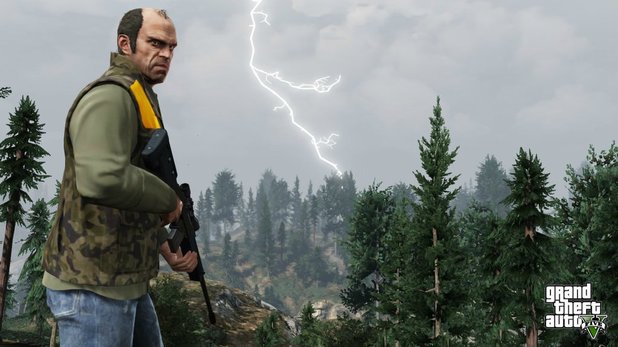
And yet, that interactivity is demonstrated best in classical chaos. Wreaking absolute havoc in a military base to steal a fighter jet and shoot down helicopters that give chase, parachuting from an obscene altitude within San Andreas’ massive skybox, or simply sightseeing cross-city, from the hanger in Los Santos International Airport all the way up to the beaches of Paleto Bay, GTA V delivers arguably the largest and most active play space in past and present gaming.
The Bottom Line
Rockstar’s games have the tendency to elicit a tingly feeling in me whenever they emerge into the scene. It’s a feeling that stems from entertainingly tabooed cultural satire, absurdly detailed and vast worlds, and a level of spontaneous gameplay that’s emergent from delicate ecosystems. While GTA V doesn’t have the best written story compared to past Rockstar titles, the best use of three protagonists in a strategic gameplay capacity, nor the most seamlessly played out missions as they could have been, it has tapped right into those very expectations I or any fan of the GTA series demand. It pulls it off with being the best mechanically designed GTA yet, the best moment-to-moment GTA yet, and by far the largest and the most dense GTA yet.
As it stands, Grand Theft Auto V is the best way to transition and/or conclude this console generation.
+ The most entertaining missions in Grand Theft Auto to date
+ The most interactive ecosystem and city in Grand Theft Auto to date
+ One of the most technically impressive games this generation
- More mission freedom and less hiccups please
- Not the best narrative in the franchise
SCORE: A
By Jamaal Ryan

Let’s take a looking at a week in gaming from 9/30/13 to 10/4/13. 

A game about slavery? Check. The Holocaust? Check. 9/30


Last week, I wrote about Thralled, an iOS side scroller puzzler game set to release that started out as a University of Southern California’s Interactive Media & Games Division project. It centers on a mother who’s a runaway slave carrying her infant in her arms along the escape.
Moving over to another one of the world’s historical genocidal atrocities, the appropriately titled Anne Frank captures a day in the life of one of the Holocaust’s most seminal victims. Currently being developed by Kira Resari as his bachelor's thesis at the Macromedia College in Munich, Anne Frank isn’t translated into a traditional game genre, but rather an interactive experience.
On October 20th 1942, players will explore the Frank hideout as Anne, interacting with members of the Frank family. Though players will be able to make decisions, their outcomes are minor; the only purpose is to set the mood for what the Frank family was enduring in hiding. Would Anne rather go get a bag of potatoes as her mother requested and possibly stumble, making noise because she’s so tired and weak? Or should she refuse and risk upsetting her mother?
As intriguing as this project is, Resari currently has no intentions in marketing this title, and instead, “perceives his historic gaming project as a cultural asset.” But if you ask me, following his wishes for the next generation to consume history through different means, it may not be a disservice to make Anne Frank available to consumers.
Source: Deutsche Welle
VIA: Polygon
Trying not to care about Half-Life 3 (10/1) UPDATE
It’s arguably the most anticipated game of all time, following a gut wrenching cliff hanger that has had us hopeful for almost 6 years after The Orange Box’s Half-Life 2 Episode 2. The idea of Half-Life 3 sits on the pedigree of Valve, who has virtually never made a bad game, and a franchise that holds presumably the best shooter of all time.
I’ve created my own defense mechanism around the just recently since fabled Half-Life 3. If anyone spoke of it, I would visualize anti-aircraft missiles shooting down the words “Half-Life 3” in a thought stopping method (a mental health coping mechanism) to avoid the aching wait of the game that never came.
Late last month, a NeoGAF post revealed that Valve has filed the trademark for Half-Life 3 on 9/29 in Europe which is the first we’ve heard of anything official about the game in years, perhaps ever. Around the world, millions of fans leaned forward to their monitors or pulled their phones in close, is this really happening?
The timing is too perfect, following the series of Valve announcements last week even though this registration wasn’t apart of Valve’s reveals. Speculators are predicting Steam Box exclusive, or at least Steam platform exclusive which wouldn’t be surprising given the history of Half-Life 2.
Half-Life 2 Episode 2 was a significant game for me. Not only was it one of the most versatile shooters that I’ve ever played, it had my single favorite moment in any FPS. The final stand-off against the army of Striders as you're defending the facility before the launch stands, to me, as the pinnacle of shooter design encounters.
And yet I don’t want to believe this news, I don’t want to get excited for Half-Life 3, I don’t want to raise my hopes only for them to be crushed again. On the same token, I can’t help but ask several questions. What does registration mean in game development? Is it in pre-production or is it much further in development? After all this time, will Half-Life 3 disappoint? Historically time has not been kind to game development, though there are exceptions such as Sleeping Dogs and Pikmin 3.
Half-Life 3’s registration is certainly compelling news, but I will continue to deny its existence, shooting more missiles at the thought to relinquish the stress of anticipation.

Writer's Note: As I've recently been made aware, the Half-Life 3 trademark registration has been pulled down, and a state by ValveTime indicated that this was a fake: 

"We can now confirm that the "Half-Life 3" trademark has been removed from the Trademarks and Design Registration Office of the European Union (OHIM) website. The entrant appears to have disappeared entirely after only being listed on the website database for little over a week, allowing us to identify that the trademark's listing was more than likely a hoax intended to generate fake buzz for a game which is unlikely to appear for several years. Returning readers may remember when we had discussed how the "Half-Life 3" listing was previously never officially checked or authenticated before its removal."

The lesson here, I as one who dedicates himself to writing about games on a weekly basis should be more aware of changes such as this, and we as Half-Life fans shouldn't get our hopes up for Half-Life 3 anytime until an official statement directly from Valve has been released.

Source: IGN
Training Future Soldiers with Video Games (10/2)
The terms “train” and “video games have been used all too often in a negative connotation when associated with one another. But what if it was used in context to preserve and save lives?
Developer Bohemia Interactive, one of the most respected military simulator developers responsible for the ARMA and Operation Flashpoint series, has been approached by the International Council of the Red Cross (ICRC) to weigh in on morality consultation for future soldiers.
Together with Red Crescent Movement, ICRC sees the value of military simulators, including their usage in NATO Nations, and how that can broaden their depiction of conflict. ARMA III teaches players coordination, tactical approach, and precision in an almost unforgiving yet valuable manner in ways that commercialized shooters such as Call of Duty and Battlefield’s run & gun, regenerative health mechanics never could. But together with this simulating environment, these human rights organizations are encouraging systems that incorporate real-time consequences for war crimes such as “scenes of torture, attacks on civilians, the killing of prisoners and the wound, attacks on medical personnel”.
Morality systems and in game punishments already exist in video games. Games like “pick your choice of decision and consequence game here” respond with the opening or closing of available in-game content, and other modern day shooters typically reprimand the player or restart missions if friendly or civilian fire is committed. But the ideas that Bohemia Interactive have implemented within this context was to integrate ways to make the player feels as if they’re truly done something wrong by the way that the game reacts.
It’s remains without saying that video games aren’t an effective way of teaching players how to pick up a gun and fight, but perhaps with reactionary systems that train the combat mind on how to strategize and maintain combat ethics, then this sentiment provides and unarguable positive influence of military simulators.
Source: Kotaku
Consumed by Deus Ex (10/3)
Looking at Eidos’s announcement of Deus Ex Universe which is set to span PC/next gen hardware, touch devices and graphic novels, and the nature of the franchise, it’s easy to see how this Cyber Renaissance series can fill these various mediums and platforms.
Deus Ex succeeded with the long awaited Human Revolution marrying the depiction of a multilayered socioeconomical universe with multidimensional gameplay. Eidos even accomplished translating that experience to iOS with Deus Ex: The Fall. As far as offering a definitive Deus Ex experience regardless the hardware, Eidos has proven themselves with two very strong titles. In addition, with the alarmingly accelerated rise in companion apps for mobile devises, I would be surprised if a networked link wasn’t planned for both stationary and mobile versions of Deus Ex.
Both Human Revolution and The Fall have evolved Deus Ex’s lore of the transhumanistic and naturalistic ethical clash and social/political standing of private corporations and less fortunate citizens. Everything from NPC interactions to diaries and newspapers to the look and feel of these alternate versions of today’s cities, Deus Ex has almost too much content, certainly more than enough to bleed over into other mediums such as graphic novels.
The assumption of MMOs is possible, but difficult to picture. Players can certainly be representative of the opposing ideals in the world of Deus Ex, perhaps in a similar manner in which some MMOs bring together warring factions. And even of these ideas weren’t gamified, the biggest gameplay appeal of Deus Ex is the augmentive choice of tactical engagement. A class system could work, but the richness comes from a single player experience designed around Duex Ex's sometimes intimate encounters. Perhaps this “connected game world” would entail single player missions that effect community game world of some kind.
I’m not a graphic novel guy, but I can certainly appreciate and see the potential of a more passive and in-depth method of telling stories from the Deus Ex Universe. However a next gen installment with possible communication with a mobile version and whatever this “connected” experience may be can certainly work if given the proper treatment to the societal strengths of the Deus Ex franchise.
The Death of Two 5 Year Olds After Gaming (10/4)
The last words little Koushi heard was, “Which is more important: Your game machine or breathing?"
After getting his Nintendo DS thrown away by his mother Shizu Shigeta as punishment for not cleaning, as any five year old would do, he asked for it back. She then coldly issued this very question to him. Five year olds aren’t expected to grasp the full concept for life and death, especially with in the context of that question. As expected, he answered “Game machine”. This then triggered the mother to tie up little Koushi in two plastic garbage bags where he suffocated to death.
Too tragic and heavy a story? Here’s a touching one…
On the tombstone of another 5 year old boy in Lund Sweden pictures him sitting nearly embraced by angels wings while he plays Pokemon on a Gameboy Advance SD. As you look closely, you can see an etched in picture of a Graveler on the screen. What a thoughtful and loving gesture to a child who loved video games.
Sources: Kotaku & Kotaku

A WEEK IN GAMING 9/23/13 TO 9/27/13. SPECIAL FEATURE INSIDE

No comments

Monday, September 30, 2013

By Jamaal Ryan

Sorry for the late post folks. Between moving and watching Breaking Bad's series finale (could have been better), I missed the week's updates by a day.

Let’s take a looking at a week in gaming from 9/23/13 to 9/27/13. This past week has had some interesting news about gaming and parenthood. Below is a feature about one mother's decision to purchase GTA V for her 13 year old son, and what other gamer parent's perspectives are one violent video games for their children.

Note: My review on GTA V could come as early as next week's updates, however it'll be without GTA Online's coverage which is set to launch tomorrow.

Kinect's justifications was also one of TGS's weirdest games (9/23)


This past Tokyo Game Show was large in part another celebration of the Playstation brand in many ways, from the Vita TV to the many titles announced for its platforms. However one of the show’s standout games wasn’t only an Xbox One exclusive, but a Kinect title: D4.
Much like some of the known-by-name games seen at the show, D4 came back with a return showcasing, following its brief announcement at E3 earlier this year. We now know more about the Kinect powered title from the minds that brought you one of the worst/oddly brilliant titles current gen, depending on how you look at it.
D4: Dark Dreams Don’t Die, stars David (I’m sure the name was dee-liberate), a detective who solves crimes with his ability to access the past by touching mementos. Certain actions will have David imitate your gestures such as touching your temple to activate his Vision ability which draws your attention to certain objects, and splashing water in his face to replenish his usage of it. Fight scenes warrant quick simple gestures such as those seen all the way back at E3 like broad arm swipes.
D4 doesn't hold back from Swery's strange imagination either with fights on a plane involving using mannequin limbs to play combat baseball, and strange women dressing and acting like bunny rabbits. It’s a bizarre game of Sweryian proportions, and it probably wouldn’t have existed if it weren’t for Xbox Ones coming packed with a Kinect in every box.
Kudos to Microsoft for sticking to their guns and not spinning another 180 by pulling the sensor out of the SKU after taking away the Kinect requirement for system operation. Kinect is a valuable part of the Xbox One platform, not only because the operating system considers it, but it incentivizes developers to incorporate its functionality. The original Kinect was a success on 360, churning up some exclusive software, but those publishers took a big risk – in light of an assumed generous payment from Microsoft – because not every system would ever have a Kinect companion.
But as part of the Xbox One’s platform, developers can take the unit into consideration; we’ve already heard of some developers thinking of incorporating them into their controller primary games such as Battlefield 4. Granted, this is a present day advantage; who’s to say that the console itself won’t ship on its own in the future?
D4 isn’t Kinect only as it’s also compatible with the regular controller. But even though Swery and his team are odd fellas, if a Japanese developer is looking to lead their software with Kinect on Xbox One, it’s a hopeful sign that future publishers and developers (a special mention for independent developers with Microsoft’s indie change of heart) will come up with more creative titles for the Xbox platform.
A game about a runaway slave and her baby (9/24)
The level opens with a mother holding her crying baby as she pulls it close to her chest, whispering that familiar “Shh Shh Shh Shh…” in a motherly tone trying to softly quiet her child. You have to admire her maternal resolve as she’s a runaway slave.
Isaura, we’ll call her, presses forward into the rainy forest with baby in arms in standard 2D platform affair until she faces her first obstacle. Think Limbo-like encounters as she must solve small puzzles in order to continue her escape. She must free her hands to clear the path, so she puts her baby down on the ground. The lack of warmth from its mother’s arms upsets the child, and then starts to cry. Isaura clears the way and picks up the one thing that has motivated her to embark on this venture and continues on.
Thralled, an iOS side scrolling puzzle, began as a student project from the University of Southern California’s Interactive Media & Games Division by Miguel Oliveira and now his small team. It tells a specific story within the era of slavery in Portuguese Brazil in the 1700s.
It’s a profoundly important project, willing to create an period experience around one of the world’s most controversial subjects that also happens to be several hundred years old; though it must not be forgotten that modern day slavery is alive and well with well over 20 million slaves today.
As gamers and game developers alike get older, we begin to see titles thematically discuss the idea about parenthood. Popular games such as The Walking Dead Season One and The Last of Us to smaller and more direct titles such as That Dragon, Cancer live outside of game mechanics and ignite that aching sense of protection.
"Who can understand slavery if you have not been through that kind of an experience? But everyone can understand the bond between a mother and her child and so that is the link between us and the slavery experience," Olivera says. Thralled very much has that relatable potential.
Last month I had the experience of watching Fruitvale Station (spoilers through till the end of the next paragraph), and the moment when Oscar Grant was shot in the back drove a double edged parental sword into our hearts. With blood dripping from his lips, he repeated, “I have a daughter! I have a daughter!” Fast forward to the scene at the hospital where his mother had the heart breaking moment of seeing her son’s corpse on the table and her chest caved in, everyone understood her pain.
My girlfriend and I were the only two Black people in the theater, and yet Oscar’s dying thoughts of leaving behind a fatherless daughter and his mother mourning his death struck everyone else to tears.
Though slavery, particularly Black slaves, is engraved in the history of those from African Decent, a story about a mother trying to save her child is universal. Thralled is completely funded but still needs staffing to complete the development, and it has my best wishes for its App Store release.
Sources: KotakuPolygon
Nope, Fuck You. You're banned from playing video games (9/25)
The mother of Jeffery Ehlers reports that her seventeen year old son was screaming obscenities at his television who was losing to a particular Playstation 3 video game. She goes on in adding that she asked him to stop, and threatened that she’ll take the console away from him. After his alleged refusal, she unplugged the system (She must have played GTA V and after seeing Michael smash his son’s TV, thought that this was a good idea… violent video games elicits bad parenting).
Expectedly, yet unfortunately, her statements report that Jeffery loses his temper, shoving her, throwing objects and slamming doors. After being arrested and taken to the Racine County court in Wisconsin to be charged with disorderly conduct, the judge issues an order. Jeffery’s punishment: possible 90 days in jail if convicted, and he will be banned from playing video games.
There are so many questions to ask here:
Was this Jeffery’s first outburst, or has he demonstrated temper tantrums in the past?
Likely not. A young man that age may have started showing signs of troubles controlling his anger before he hit puberty.
If this was a repeated incident, had the mother thought of addressing the issue by seeking professional intervention?
Depends. Children respond differently to different styles of intervention which is based on different factors. Most therapeutic treatments for teenagers are non-consensual, meaning that the parent requested therapy, not the child. Also, a child’s social skills can influence their response to therapy. If they’re not very verbal, then a face-to-face interaction might not have been the best course of action. Some respond better to therapy while taking walks or with low stimulating activities.
Has Jeffery only lost his temper playing video games?
I’m willing to bet not. Anger doesn’t just generate around a specific activity. The mother may notice it more when he’s playing video games simply because it’s the only arena where he’s competitive, or she may have a biased fixation to the point that she’s much more aware of his behavior playing video games than other activities.
What is the history of the relationship between Jeffery and his mother?
As one who has a complicated relationship with my own mother, I can empathize with Jeff on his frustration in dealing with his mother. Parents can be triggers, igniting a “sore spot” that sets our emotions off. We may be tolerable when our boss or teacher tells us that we’ve lost privilege of something, but the minute our guardian says it, it triggers a reaction in response based on past experiences and our knee jerk expectations.
How long is Jeffery banned from video games for?
This is a valid question. Reports stated that the judge ordered the banning, but is it weeks, months, years?
Can a judge actually ban someone from playing video games?
I’m a licensed social worker, not someone with a degree in law or criminal justice; but I’m willing to bet the answer is no. Video games is a form of media, just like movies, films, music and books. Can someone be banned from reading, watching a flick or a show, or listening certain albums based on unruly behavior? It doesn’t make sense. Especially given the fact that Jeffery is 17, meaning that he is of legal age (legal is a harsh word) to consume M rated games.
In addition, video games aren’t a substance or a proven source of psychological damage; it doesn’t cause explicit harm to players. Having said that, it would make sense if there were stipulations that required him to never touch alcohol, but being banned from playing video games seems a bit too extreme to say the least (note: I have not read if it was a court order. Not sure if there’s a difference between a judge saying that he is banned, or being issued an explicit court order).
The criminal justice system in this country...
...isn’t perfect by any means. I see it with my clients in psychiatric hospitals and out in the community; one of the worst recent examples was the Montana District Judge G. Todd Baugh who sentenced former Billings Senior High School teacher Stacey Rambold to 30 days in prison after raping a 14 year old girl who later killed herself.
The judgment calls by these “judges” are troubling, seemingly rooted in biases and personal beliefs. Jeffery Ehlers needs help, but this Wisconsin judge might need a new profession.
Source: WISN 12 News
VIA: Kotaku
WTF Knee Jerk: Valve's Steam Controller (9/27)
First, shut up about Half-Life 3. It ain’t happenin’
Valve has had a series of announcements this past week including their Steam OS and their hardware partnerships. But they left a visually tangible (I’ll pretend that’s an adjective) and easily conceptual reveal for last, the Steam Controller. The owl jokes are warranted, it’s a strange looking piece of hardware. Concave clickable track pads, clickable touch screen in the center, which is boxed in by your formerly traditional ABXY now manning its four corners.
After looking at the concept design and the actual photos, I immediately picked up a 360 controller, regarded as the most ergonomic controller of all time, and pictured it in my hands. The pads, while missing the firm resistance of traditional analog sticks, could be a vast improvement for precision over our tilting “thumb-chairs”. The size of the bowl looks to cradle thumb movement enough while offering potentially more sensitivity for – and I hate to be a traditionalist – genres like shooters.
The mapped out ABXY doesn’t seem like a bad idea either. We’ll have to reteach ourselves, sure, but they’re within enough reach from the thumb pads to avoid odd contortions. The touch screen that sits at the center of the 4 buttons can be serviceable, giving a larger surface than the DualShock 4’s touch pad with visual feedback.
My only issue, and rather large one, is the absence of a D pad. We can immediately think of equipment management that can be pulled from the D Pad to the touch screen. But even that within itself requires longer travel than what I’m comfortable with. But more crucially is the exclusion of 2D style games which are always better with a D Pad. Looking at the Steam Controller, there doesn’t seem to be any comfortable way of playing these types of games.
That was my knee jerk reaction, happening well before the “haptic feedback” and “resonant actuators” jargon sinks in. Valve’s partnerships, OS, and even this controller interest me, however it’s the hardware itself that raises the other brow. Xi3, maker of the allegedly former Steam supporting Piston announced at CES 2013, is set to make announcements this upcoming week week. Who knows if Valve and Xi3 have reunited again, but I’m just looking for a console style PC in which I swap out cards like they’re SNES cartridges.
A Week in Gaming Special Feature:
This woman bought GTA V for her 13 year old son
Originally reported on September 26th 2013
If there’s one game that has ever deserved a hard M, that’s most certainly GTA V. Endless killings of innocent bystanders, prostitution, drugs, and some deeply disturbing content, it doesn’t get more “For 17 and older” than this. But one woman, after some long thought, decided that this will be her 13 year old son’s first violent video game.
Wendy Williams, host of the Wendy Williams show, proudly admits to buying GTA V for her 13 year old son. Part of her justification can be troubling to some, as she concerns herself with “Little Kev” looking like a freak and a weirdo for not having the cool game (though she completes her point by adding that she’s taking responsibility in keeping an eye and the activities that her son and his friends engage in). Her point was well criticized as another co-host on the panel calls her out for jeopardizing the parenting values of other children who are present in her house playing GTA V. But despite her wanting her kid to be cool and enabling other kids to go home and complain to their parents, “But Kev’s mom got him GTA V!”, Wendy is well aware of the content in this game, and invests their trust as his parents in knowing him enough that they believe he can handle this very mature game.
GiantBomb’s Vinny Caravella was asked if he will expose his son to children’s games or mature games, considering that their content will be more realistic than today’s games, if he’s ready for mature games. The question answered itself, but Vinny’s answer was concrete yet profound. He simply answered, “Then he plays those games.” He elaborates the importance of making a judgment call based on the child’s individual personality. And while he doesn’t belittle the ESRB age appropriation, he points out that maturity of the child is what matters.
Yup, she's ready.
Father of four boys, Colin Campbell – formerly of IGN who now writes for Polygon – wrote his own advice in being a video game parent. His first rule presented a stark difference between parents like Wendy who know exactly what they’re buying their children, and those that just don’t care. As much as we gamers are informed consumers for ourselves, those who are parents should be just as informed of the games they’re allowing their children to play.
About two months ago, I came across a video of a gentleman who responded to accusations of games eliciting violent behavior in children. As a hopeful father in the future, this (non-verbatim) quote will lead how I will raise my children around video games: “I don’t believe games makes kids violent. I do, however, think it’s important to be able to teach kids the difference between video game consequences and real life consequences. Sit down with them and ensure that they understand that this game action isn’t okay in real world society.”
As a former youth counselor for teenagers in a group home, I allowed my kids to play violent games. I often used exposure to video games – even violent ones – as a preventable measure from excessive behavior. Looking at today’s children, it's important to know that they are exposed to far more mature content, both in media and in real life, than many of us were when we were children (for those of us in our twenties and older). They’ve told me stories that I could never imagine myself in when I was their age. Playing Halo or Gears of War changes nothing in their lives. My job was to reinforce good behavior and reprimand bad behavior; violent video games were hardly an influence to these raped, homeless, neglected and battered victims.
You all know what I’m going to say. Monitor your children, study their behavior, make choices based on their ability to separate their super ego from their video game id. Wendy seemed comfortable with it, Vinny looks forward to it, and Colin practices it with his four children. Anytime I hear a parent blame video games for their child’s violent behavior, I ask, “What’s your excuse?”

A WEEK IN GAMING 9/16/13 TO 9/20/13. SPECIAL FEATURE INSIDE

No comments

Sunday, September 22, 2013

By Jamaal Ryan

Let’s take a looking at a week in gaming from 9/9/13 to 9/12/13. Below is a special feature about my experience as a first time Diablo player.

First Three Hours of GTA V Spoiler Free (9/17/)


Well, that was the longest install I've ever had to sit through.
Being that Rockstar games are so infrequent, I’m certain that I’m not the only one who initially feels that navigating characters controls like someone walking for the first time after being in a coma for a month. Needless to say,  it took me a while for me to get used to GTA V's unconventional controls; the weighty pick up, the momentum shift in changing directions, these are very different mechanics, those in which are less noticeable over time but never forgotten.
It took me half the time to pick up on the tighter driving. Lighter vehicles control better than others as they have a tighter grip to the road than heftier models. However some cars allowed me to spill all over the road more than others; the mere stark difference was unusual, but perhaps vehicle customization might justify that.
I'd have to say, the first mission didn't do the game any favors in terms of visuals. The vibrancy we’ve seen in screenshots and trailers were missing to be replaced by a bland color scheme and poor lighting. This could easily been explained by the weather conditions and the linear nature of the mission, but it just felt strange.
It was when I entered Los Santos when I was in awe.
Big city. Bright lights. Driving towards the outskirts of Vinewood toward rolling hills dotted with shrubbery all emphasized with the game's insane lighting made my jaw drop. The level of scope in GTA V is astounding, and the level of minute detail is equally impressive. Of everything I saw, Lamar's flip flops lifting off the pavement to the souls of his feet instead of being glued to it displayed the level of care Rockstar put into their animations.
When not in the action, the only thing that pulled me out of my constant gaze of the city was Rockstar’s quintessential dialogue. The banter between Franklin and Lamar quickly reminded me of the Friday movies, the feel good neighborhood films for us Black folks. It brought back that San Andreas feel, only more believable and much smarter.
My first money shot moment was pulled off in a spectacular fashion as the game just manages to succeed keeping you in control while everything around you goes to shit. If this is signs of what's to come, the game will allow you to trigger cinematic camera angles to get a look at the action up close while prompting you what to do in enough time to keep everything moving.
My last mission presented the gun play in full force. It's Max Payne 3 in GTA V's body. The cover system is properly magnetic and much more reliable. And while the soft aim is still there, the camera acceleration is much smoother, allowing you to kill with confidence. I didn't do so well admittingly, but I can't wait to get into more firefights to test my body count skills.
I didn't get much done in the three hours (2:40 if you discount the download time) because of the pedestrian distractions that kept pulling me every which way. Cruising jamming to Kendrick Lamar and Dr. Dre, or enjoying a shamelessly racist cartoon and later listening to upended political propaganda, GTA V lives outside of you whether you experience it or not, and I can’t wait to see just how much blood is pumping through this city.
I do have an issue with character switching. It’s quick and instantaneous when each are just meters of one another, but across the city, it take full seconds to switch from one to the other. I’m not sure if it’s my system or disc, but I’ll be very unhappy if this interrupts any missions.
I can’t say much for the game thus far. In this massive game, I’ve yet to meet all the characters, and with the exception of the money shot moment, this installment has been baseline errand boy GTA. But I’m confident that’s gonna change within the next hour or two as I’ve seemed to come across the moment that bring these three together in doing what we know them to do.
Look forward to my review in October.

MGSV Excites Me from Tokyo Game Show (9/19)

Much like the genre that it inspires, Metal Gear Solid V snuck up on us at its official debut at the beginning of Microsoft’s E3 2013 press conference, then hardly to be heard from again. The most attention that it has gotten since then was the studio’s controversial statements of making Quiet more “exotic” and “sexy” (I’ll leave that one alone since I’ve written enough about gender issues in video games).
Stealth games have historically walked the narrow path of pass or fail; and within the last ten years, games like Splinter Cell have grown to give players more direct methods of engagement options, and others such as Thief, Dues Ex: Human Revolution and Dishonored have gifted players a respectable amount of volume allowing more flexible ranges of approach.
Metal Gear Solid V arguably inflates that space to a scale that wows us almost just as much as what many of us are experiencing now in GTA V. Not only is there an incredible amount of real estate to cover in each area, but the level design and the environment looks to give us a near infinite amount of stealth options such as hanging off the side of a horse, and using night time and weather conditions to our advantage.
Now I must admit, in isolation, the Tokyo Game Show demo wasn’t all that exciting in and of itself to look at. But there were some neat tricks that show how Kojima Productions is paying attention to the genre at large and implementing new gameplay options in their own right. Much like games such as Splinter Cell and Far Cry 3, enemies can be marked and tracked throughout the environment. There are also several occasions where enemies are seen through walls which draws a heavy comparison to games like the Batman Arkham titles.
There also seems to be more of an empowering reaction to being spotted by enemies when up close. It looked as if limp bodies can be thrown for an instant KO which is hilariously overpowered in its own right. This action was done when time slowed after an enemy was alerted; it's an interesting design similar to games that lend a short window to silence the enemy (oddly enough, the modern Goldeneye reboot comes to mind) before others become aware of your location.
It was a raw demo from start to finish of how one can infiltrate and enemy base from any angle and any approach that would indeed be far more exciting to play than to watch. But when keeping in mind again the environmental tools and adaptations along with the traversal freedom, Metal Gear Solid V could set a standard in modern stealth action games.

Is there a history of violent video games and gun violence? (9/20)

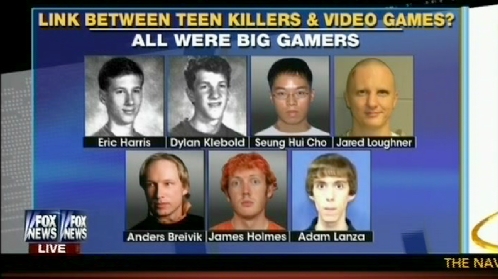
And so it continues. Another horrible tragedy in the form of a mass shooting, and another perpetrator who just happened to play video games. From Columbine to Norway to Sandy Hook to the most recent tragedy in DC involving 12 killed at a naval base, the media and video game naysayers point the finger at mature rated games as the cause and even the influence. Some might go as far as to say that games are the problem, not guns.
It’s an absurdly narrow hypothesis, especially considering that gun violence – and in this case, mass shootings – have been an active deadly part of American society for decades. Know the term “Going Postal”? It originated from the series of mass shootings that happened to take place at US Postal Offices beginning in 1986 at Edmond Oklahoma where 15 were killed including Patrick Sherrill, the shooter, who turned the gun on himself.
Though many unofficial trackings date mass shootings back to the early 80’s, a decade where the term “violent video games” was hardly conceived, the oldest known mass shooting marks all the way back to 1764, where it’s horrifyingly coincidental that it was also a shooting where the fatally wounded were students and a teacher.
Television wasn’t even invented yet, let alone video games.
Take away the video games, and what are you left with? Nearly 250 years work of historical mass shootings, and 225 years’ worth if you discount shootings that have happened between this past Monday and the year 1990, the beginning of an era where violent shooters have developed since Wolfenstein 3D.
Centuries ago, the blame might have been on possessions of some kind. Decades ago, mass shootings might have been scapegoated by music and television; now we’re up to video games.
I just hope I grow old enough to see where the tides shift next.

A Week in Gaming Special Feature:
I've Lost My Diablo Virginity
Originally reported September 16th 2013
Diablo is a game about getting new shit thrown at you all the time. Having not played any game in the series before it, and only getting a chance to experience it on 360, I finally got the “Diablo Hook”.
Diablo is surprisingly more of a demanding action RPG than I expected it to be. Enemies’ patterns mimic that of more conventional action titles with hazardous obstacles and broadcasted attacks as you're made capable with incredibly responsive controls that enable you to trigger and cancel attacks instantly. As a Monk class, I heavily rely on Tempest Rush which is designed as both a defensive and offensive maneuver. I can deal damage and inflict effects on my foes, but at the same time (in my opinion) it’s primarily useful for getting out of a jam since it cuts directly through enemies.
This isn’t the makings of a typical RPG, this rooted in action game mechanics.
Those who’ve played Diablo for years will process this as if it’s second nature, but from an outside-looking-in perspective, this might have been beyond the expectations of those who’ve never played Diablo.
One take away that I can honestly say has changed my perspective in RPGs in the future is rooted in Diablo’s basic combat. I’ve always felt more comfortable with the basic Warrior/Barbarian classes as a way to avoid managing magic and low defense. And though the Monk isn’t particularly a departure from that play style, being that Spirit is recharged by basic attacks – and not like other archaic RPGs where it’s based off of potions of some kind – it incentivizes me to try new classes and perhaps do the same in future RPGs from here on forth.
Loot and leveling up are what defines the Diablo experience for me as I’m sure it does for veteran players. The gear that I’ve obtained while playing Diablo has been extremely empowering. Early in my campaign, I augmented my Monk with armor that has health regenerative features. That, combined with the Mantra of Healing meant that my health kept fighting to stay full… and was winning. Now as I’m currently grinding, I’ve shifted to prioritizing gear that empower extra experience, making that climb to the next level even faster than it normally is.
Discovering that I can sit down for a small reasonable amount of time and see the next level kept me glued to my seat. I was ecstatic to see how Diablo 3 rewards you with something new every single time you level up. Not all the abilities are game changers; many of them I’ve skipped to continue my adherence to my play style, but just knowing that something new was around every corner turned 30 minutes into hours.
As I’m writing this, I’m in the middle of a multiplayer match; that alone makes Diablo 3 the most user friendly co-op game I’ve ever played. This, along with the basic principle of consistently rewarding the player, is where I can now see where the term for Borderlands “Diablo with guns” came from.
Better with friends.
The story in Diablo is secondary… hell, even third-dary. I crushed the hellish Diablo within minutes and jumped right back into multiplayer to see how far and how powerful I can push my Monk to be. The loot is better. The experience gain is faster. The battles are tougher. All three aspects of multiplayer to me feels cradled by how adamantly it is designed to keep players together. Borderlands 2 beat for beat, drew inspiration from Diablo’s multiplayer format, but one of the key features it missed was loot exclusivity. I hated it when a gun with a purple beacon shot out of a corpse only to see some asshole sprint by and pick it up, or worse yet, make an entire pile of loot vanish in one fell swoop. With the exception of when a fellow player gives up his gear, that never happens in Diablo 3. In addition, I equally value being able to teleport back and forth from a hub village, and by interacting with any one of the fellow players’ banners, jump right back into the fray. Blizzard clearly wanted to make the player experience as barrier free and progression heavy as possible. And for me, it succeeds in every conceivable way.
For me, Diablo 3 came out at an inopportune time.  The two weeks that I spent with it wasn’t enough with GTA V shipping tomorrow. But with several classes, several difficulties, endless loot, and addictive design, after experiencing it for the first time, Diablo 3 has my respect for one of the most definitive RPGs in the video game spectrum.
Top